Every corporate board and startup founder in 2026 is asking the exact same question: “How quickly can we integrate Generative AI into our operations?”
The promises are massive: automated workflows, predictive customer insights, and lightning-fast decision-making. But behind the glittering case studies lies a quiet, expensive reality: up to 80% of enterprise AI initiatives stumble out of the gate.
The issue isn’t the AI models themselves. The problem is the data feeding them.
If your business is looking to leverage Gen AI integration for business, it’s time to look past the buzzwords and address the foundational piece that makes or breaks the technology: your data architecture.
The AI Trap: Garbage In, Garbage Automatically Out
Plugging a highly advanced AI model into a fragmented, unorganized data ecosystem is like putting a Formula 1 rocket engine into a rusty station wagon. It might look impressive on paper, but the moment you hit the gas, things are going to fall apart.
Generative AI relies entirely on context. If your customer data is trapped in isolated silos, your financial metrics are outdated, and your operational logs are messy, your custom AI tool will do one of two things:
- Deliver completely irrelevant results.
- Suffer from “hallucinations”: generating confident, highly articulate, but completely incorrect data.
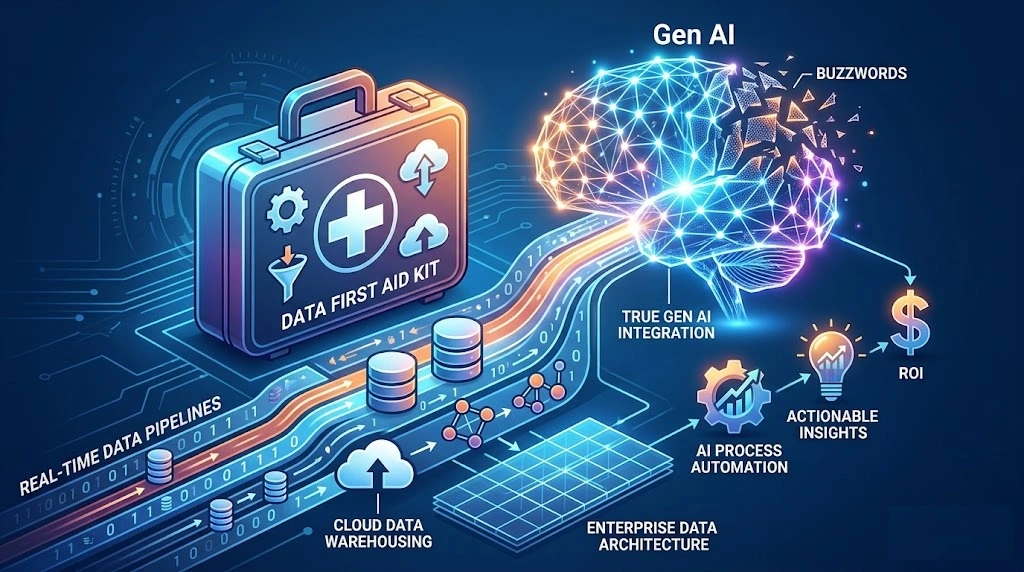
To build an AI system that actually drives business metrics, you don’t just need an AI strategy. You need a data first aid kit.
The Three Pillars of a Robust Data Layer
Before diving into custom AI development, successful organizations ensure their data infrastructure can handle the load. True AI process automation requires a clean pipeline. Here are the three pillars you need to establish first:
1. Unified Cloud Data Warehousing
If your data lives across five different legacy platforms and mismatched spreadsheets, an AI cannot efficiently scan it. Modern cloud data warehousing in the US has evolved to act as a single source of truth. By centralizing your data into a secure, scalable cloud repository, you give your AI a clean, organized library to learn from.
2. High-Fidelity Data Pipelines
Data changes by the second. An AI assistant pulling from a report generated last quarter is useless to a live customer service team or a dynamic logistics grid. Real-time data pipelines act as the nervous system of your business, continuously extracting, cleaning, and delivering fresh data straight to your AI models.
3. A Modern Enterprise Data Architecture
Think of enterprise data architecture as the blueprint of your digital house. It defines how data is categorized, who has access to it, and how it is secured. Without strict architecture and data governance, an AI model might accidentally surface sensitive HR files or restricted financial data to the wrong user roles.
Turning Raw Data into Real-World Automation
Once your data pipelines are clean and your cloud warehouse is optimized, the magic actually happens.
Instead of a generic chatbot that recites canned FAQ responses, a data-backed AI integration can look at a customer’s entire five-year purchasing history, instantly cross-reference it with current warehouse inventory, check real-time shipping logistics, and handle a complex return or upsell in seconds—completely unassisted.
This isn’t sci-fi; it’s standard practice for companies that prioritize engineering over hype.
The Bottom Line: AI is only as smart as the data pipelines feeding it. If you want a digital tool that truly transforms your business, start by giving it a clean foundation.
Ready to Build an AI System That Actually Works?
At AppsDeddy, we don’t just build standalone apps: we engineer smart, end-to-end solutions. From designing robust data pipelines to deploying advanced, secure AI models, we help businesses across the United States unlock real operational value.
Get a Free Consultation with our Indianapolis-based team today, and let’s map out your custom data and AI strategy.